Drive around Lawrence or Monroe County and you'll spot them: retaining walls leaning out at the top, courses pushed apart, caps sliding off. The block almost never fails. Water does.
Soil behind a wall gets heavy when it's saturated. Dry soil pushes on a wall with real force already; add water and that pressure climbs sharply. A wall built without a way to relieve it is simply waiting for a wet spring.
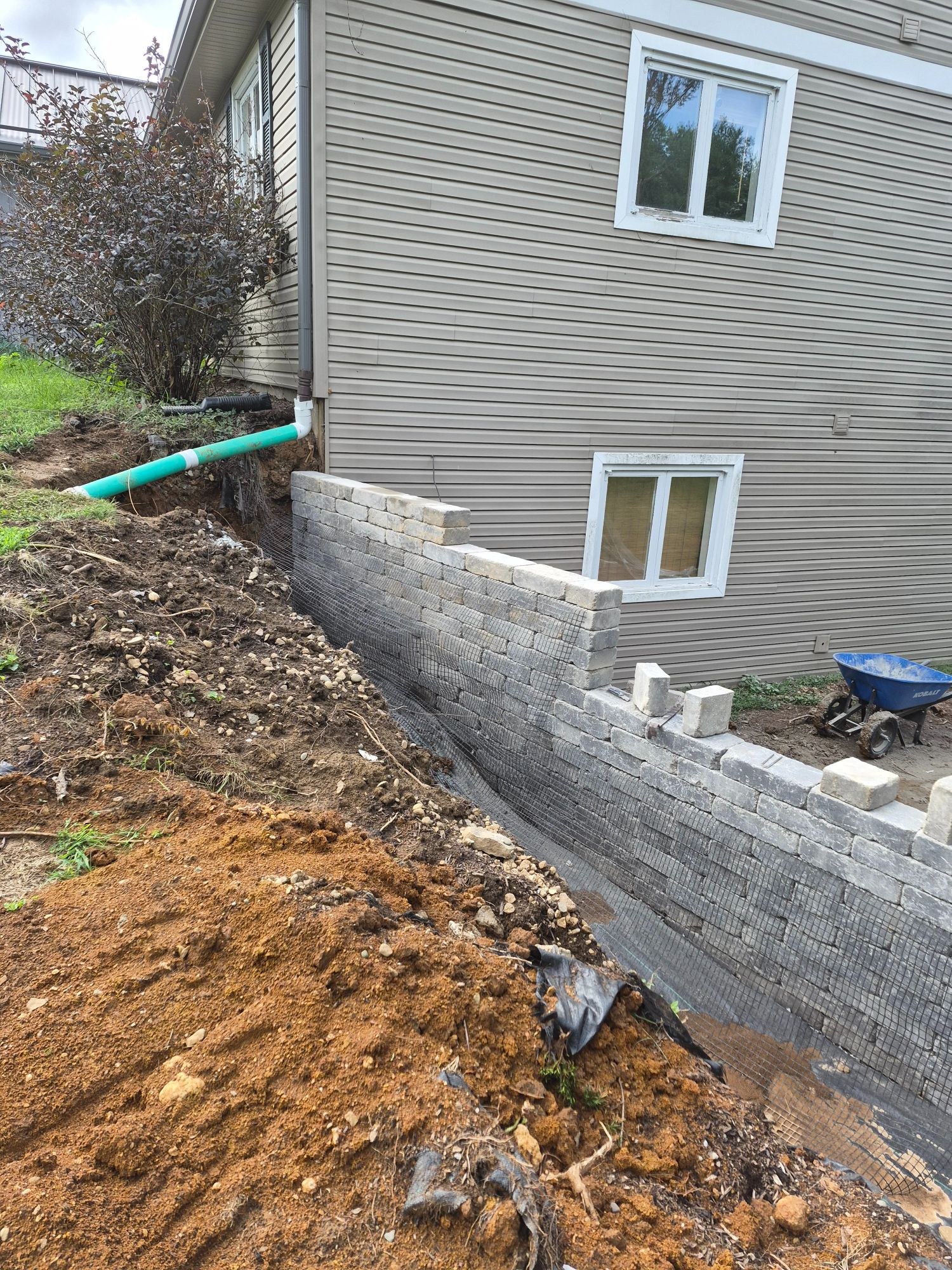
So we build the drainage first. A trench of washed stone runs the full length behind the wall, wrapped in filter fabric so silt can't clog it, with an outlet that actually daylights. Water gets a path out instead of pooling against the block.
Underneath, the base matters just as much. We excavate below frost line, compact a stone footing, and set the first course dead level — because every course above it inherits whatever that one does.
On taller walls or anywhere the wall carries a load like a driveway, we add geogrid: layers of mesh that extend back into the soil and tie the earth and wall together into one mass.
None of this shows once the job is done. That's the point. If you're comparing quotes on a retaining wall, ask what goes in behind it — that answer tells you more than the price does.